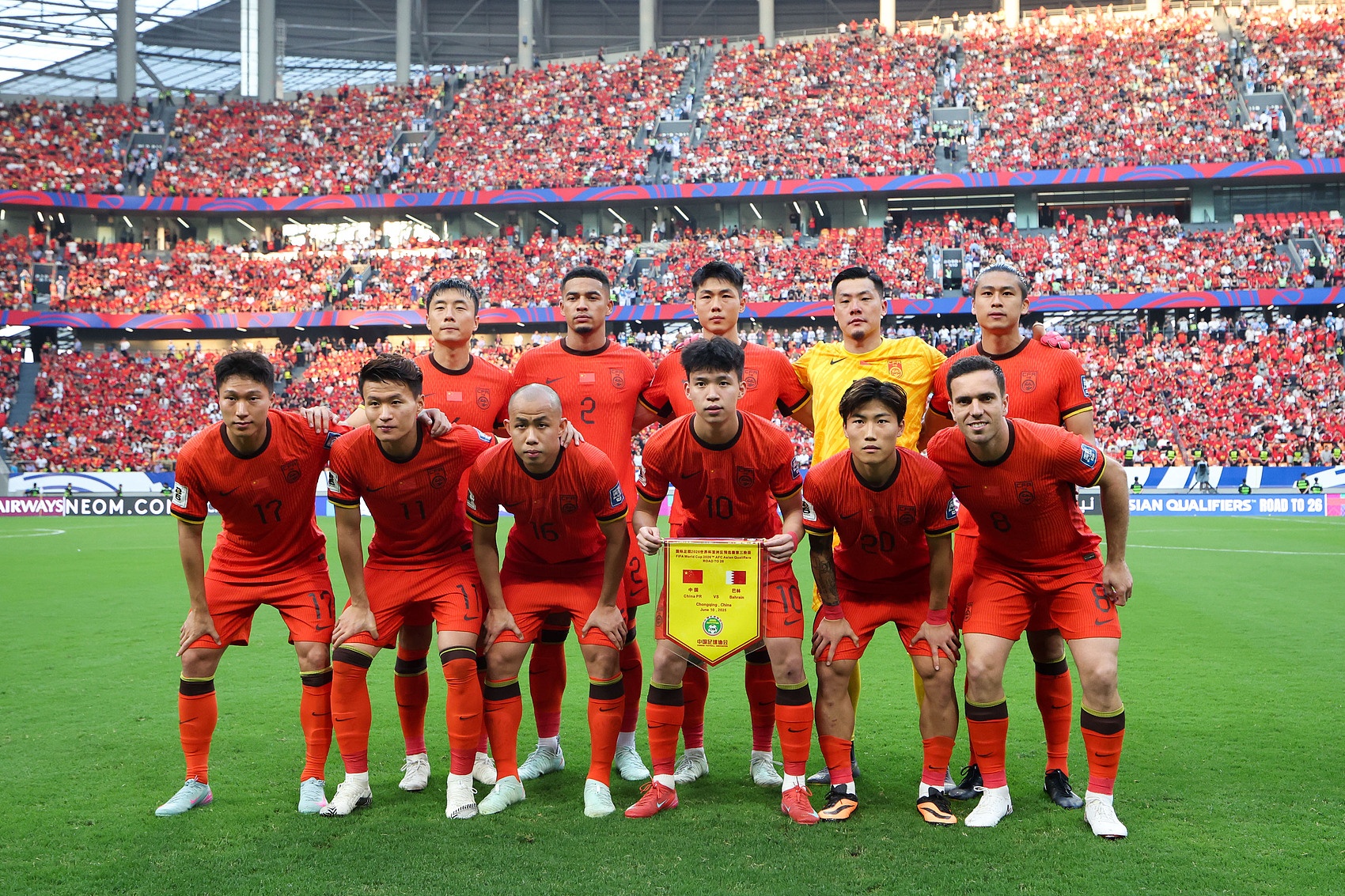
1BSPORTS 1B Sports June 12th news Since Milu led the national football team to the 2002 South Korea-Japan World Cup finals, in the following 20 years, the position of the national football team coach changed frequently like a revolving lantern, and a total of 14 coaches (excluding Milu).
Behind the frequent changes in coaches, the national football team’s performance has always been difficult to break through, and its position in Asian football is becoming increasingly embarrassing. This phenomenon is worthy of in-depth analysis.
After eliminating the 2002 World Cup group, Ali Han took over the coaching post and led the team to the runner-up in the Asian Cup in 2004, which is one of the few highlights of the national football team.
But in the 2006 German World Cup Asian qualifiers, the Chinese national football team was eliminated due to a disadvantage in goal difference, and Ali Han was also dismissed.
Since then, Zhu Guanghu coached for a short time, known as the “mad dog spirit”. Although he won the championship in the semi-finals of East Asia, he was eliminated in the more important 2007 Asian Cup group, setting an embarrassing record of not qualifying for the first time in 27 years. Zhu Guanghu was dismissed. From 2007 to 2008, the coaching model of Fulado (executive coach) and Dujikovic (head coach) did not improve. In the South African World Cup qualifiers, the Chinese national football team performed poorly and was eliminated at the bottom of the group.
In 2009, Gao Hongbo took office. He led the team to defeat South Korea 3-0 in the 2010 East Asian Final Four, breaking the 32-year “HK fear” and winning the championship. He also defeated the French team 1-0 in the warm-up match, giving fans hope for a while.
However, the 2011 Qatar Asian Cup national football team failed to qualify, and Gao Hongbo was removed from his post before preparing for the 2014 Brazil World Cup Asian Preliminary Group.
The Spanish coach Camacho was replaced by the famous Spanish coach Camacho. During Camacho’s coaching period, the national football team performed terrible. Not only did he lose 0-8 to Brazil, but he also lost 1-5 to the Thai team at Hefei Stadium in 2013, causing an uproar and was eventually terminated by the Football Association early, and the Chinese Football Association also paid a huge liquidated damages for this.
In 2014, Frenchman Perrin took charge of the national football team. In the Asian Cup, he led the national football team to win all three groups in the group stage, but in the World Cup qualifiers, the situation of the national football team qualifying was critical, and Perrin was finally dismissed.
In 2016, Gao Hongbo entered the palace for the second time, but after losing 0-2 to Uzbekistan in the World Cup away qualifiers, he announced his resignation after taking office just over six months.
Then, the famous Italian coach Lippi took over. In the round of 12, he led the team to defeat South Korea and Qatar, 3 wins, 2 draws and 1 loss in 6 games, and scored 11 points, which made fans ignite hope again, but because the Chinese national football team only accumulated 1 in the first four roundsIn the end, he missed the Russian World Cup.
In January 2019, after losing to Iran 0-3 in the Asian Cup, Lippi resigned in anger. In April 2019, Lippi took over the national football team again, resigned after losing 1-2 to Syria in the World Cup qualifiers, and left a famous saying “I don’t want to steal money.”
Since then, Li Tie became the head coach, and his results in the top 12 were not ideal. Li Xiaopeng took over, and his results in the qualifiers were still bleak.
Later, the national football team coached by Jankovic did not meet fans’ expectations in various competitions.
Until now, Ivankovic’s single midfielder tactic has aroused huge doubts from the outside world, and Ivan coached the national football team’s official record of 3 wins, 2 draws and 6 losses, with a winning rate of only 27.3%. So there was another voice calling on the national football team to change their coaches as soon as possible.
Recalling the coaching process of the 14 coaches of the Chinese national football team over the past 20 years, the performance has fluctuated and is disappointing most of the time. It is interesting to note that Camacho, who has the longest term among these coaches, only 20 months, and the shortest, such as Fu Bo, only led the team to play 6 warm-up games, and Cannavaro led the team to play 2 games.
Frequent changes to coaches make it difficult to build the team’s tactical system stably, and players cannot fully adapt to the coaching style and tactical requirements of different coaches. Every new coach comes, he has to re-open the lineup and create tactics. The team is always in a state of turbulence and adjustment, and it is difficult to form a stable and mature game mode.
In addition, although some foreign coaches have a reputation, they do not have enough understanding of the characteristics of Chinese football and players, and the tactical execution effect is greatly reduced; local coaches are limited in their abilities and experience, and it is difficult to lead the team to achieve a qualitative leap.
At the same time, deep-seated problems such as the imperfect youth training system of China and the small football population base cannot be solved by changing the head coach. These factors together restrict the improvement of the national football team’s performance.
In the future, if the national football team wants to change the status quo, in addition to choosing the coach reasonably, they also need to start from the foundations of youth training and league construction, and work together with multiple parties to achieve a breakthrough.